


 Deutsch
 English
 Español
 Français
 Nederlands
 Português


 Share
Share




The 2026 scramble for critical minerals is no longer a mining story—it is the central fault line of global power. As demand for lithium, cobalt, rare earths, and gallium surges for electric vehicle batteries, defense systems, and renewable infrastructure, China's tightening export controls have collided with a new wave of US-led bilateral agreements, European recycling mandates, and Australian processing expansion. The result is a structural realignment in how the world secures the metals needed for the energy transition.
What Is the Critical Minerals Scramble in 2026?
Critical minerals are the raw and processed inputs essential to modern economies but vulnerable to supply disruption. They include rare earth elements used in permanent magnets, lithium and cobalt for batteries, gallium and germanium for semiconductors, and tungsten for defense. In 2026, the scramble refers to the race among China, the United States, the European Union, and resource-rich nations to control not only mining but also refining, recycling, and trade rules. Analysts compare the moment to the 1970s oil shocks. The contest now spans rare earth supply chains from African corridors to Australian processing plants.
China's Export Controls Reshape the Battlefield
China processes about 90% of the world's rare earths, 60% of lithium chemicals, and 70% of cobalt, according to 2026 industry data. Beijing phased in tighter licensing from February 2025 and escalated in April 2026, then restricted 10 U.S. companies in June and 14 EU firms in July. Neodymium-praseodymium oxide prices surged from roughly $80 per kilogram in 2024 to more than $480 per kilogram in early 2026. The International Energy Agency warned that full enforcement could put $6.5 trillion of downstream production at risk. There is a 12-to-18-month window to build independent processing capacity before China's dominance becomes entrenched, analysts said. These measures are examined in detail in China's 2026 export controls, while the broader policy shift is linked to China export controls 2026.
Western Alliances and Bilateral Agreements
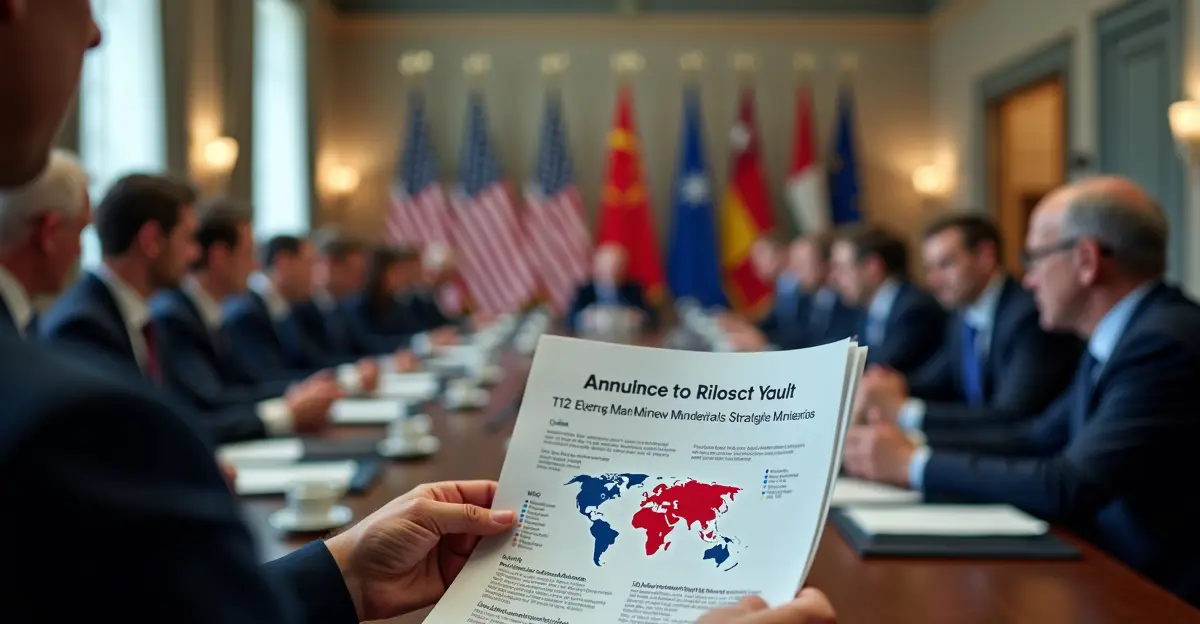
On February 3-4, 2026, Washington hosted a 54-country Critical Minerals Ministerial. The summit produced 11 new bilateral frameworks with Argentina, Morocco, Peru, the Philippines, the UAE, the UK and others, backed by more than $30 billion in financing. The centerpiece, FORGE, replaces the Minerals Security Partnership and creates preferential trade zones with coordinated price floors. The U.S. also launched Project Vault, a $12 billion strategic stockpile, while Australia's Lynas opened a major rare-earth processing plant and committed $1.2 billion to a national reserve. These moves mark a deliberate shift from multilateral diplomacy to faster, country-by-country dealmaking, as outlined in the 2026 Critical Minerals Ministerial and reflected in US EU critical minerals agreements.
- FORGE: 54-country coalition with price floors and preferential trade zones.
- Project Vault: $12 billion U.S. strategic reserve.
- Australia: $1.2 billion reserve and Lynas processing expansion.
Europe's 10-40-25 Targets
The EU Critical Raw Materials Act, in force since May 2024, sets binding 2030 benchmarks: extract 10% of consumption, process 40%, and recycle 25%. As of August 2026, the EU achieves only about 3% extraction, 15% processing, and 10% recycling. The gap means Europe needs 25 to 30 new refining facilities and an estimated €15 billion to €20 billion in new capacity. The bloc is also pursuing an April 2026 US-EU Action Plan that explores border-adjusted price floors to shield allied producers from Chinese dumping. The implementation gap is central to the Critical Raw Materials Act debate.
Recycling and Alternative Supply Chains
Recycling is the quiet accelerator. EU data show a recycling capacity of roughly 400,000 tonnes against a needed 1.5 million tonnes, pushing automakers and battery firms to build urban mines from aging EV batteries. The U.S. funded a $1.2 billion African Critical Minerals Corridor across Zambia, Tanzania and the Democratic Republic of Congo, while Argentina and Chile signed lithium agreements with Europe and India. Automakers including Tesla and BYD are developing magnet-free motors to reduce rare earth dependence. These substitution and circularity efforts feed directly into EV battery supply chains.
What This Means for Global Trade and Energy Transition
The scramble is redrawing trade in three ways. First, resource-rich nations are gaining leverage, imposing export bans, higher royalties, and demanding processing investment. Second, fragmented bilateral deals risk raising costs and undermining the global cooperation that once kept commodity prices stable. Third, permitting delays remain the weak link: new mines in Europe can take 10 to 15 years even with streamlined rules. Without faster permitting and recycling, the 2030 energy transition timelines for EVs, wind, and defense are at risk. The emerging order is best understood through the lens of mineral security alliances.
Frequently Asked Questions
Why are rare earths critical in 2026?
They are essential for permanent magnets in EV motors, wind turbines, defense systems and consumer electronics, and China controls about 90% of processing.
What did China do in 2026?
Beijing tightened export licenses, restricted 10 U.S. companies and 14 EU firms, and banned rare-earth smelting technology exports.
What is FORGE?
FORGE is a 54-country coalition launched in February 2026 to create preferential trade zones and coordinate price floors for critical minerals.
Can recycling replace Chinese processing?
Not yet. EU recycling capacity is only about 400,000 tonnes against a needed 1.5 million, but it is growing fast.

Follow Discussion